Chroma Meters | Konica Minolta
CR-410
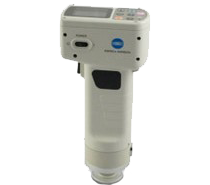
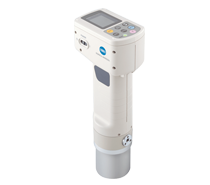
The Konica Minolta CR-410 is a portable chroma meter (colorimeter) designed for fast, accurate color measurement of textured, granular, paste, and non-uniform samples that are difficult to measure with conventional instruments. The CR-410 chroma meter features a large 50mm (Φ50mm) measurement area that averages color over a wide surface area, making it ideal for measuring foods, powders, pellets, textiles, building materials, and other heterogeneous samples. The CR-410 uses Konica Minolta's proven 45°/0° (45° illumination, 0° viewing) optical geometry, which closely matches human visual perception of color. The instrument measures color in L*a*b*, L*C*h°, XYZ, and other standard color spaces, and calculates color differences (ΔE*ab, ΔL*, Δa*, Δb*) against stored target data. With its ergonomic pistol-grip design, large LCD display, and battery operation, the CR-410 is ideal for both laboratory and production floor color measurement.
About the Konica Minolta CR-410 Chroma Meter
The Konica Minolta CR-410 is a portable chroma meter (colorimeter) designed for fast, accurate color measurement of textured, granular, paste, and non-uniform samples that are difficult to measure with conventional instruments. The CR-410 chroma meter features a large 50mm (Φ50mm) measurement area that averages color over a wide surface area, making it ideal for measuring foods, powders, pellets, textiles, building materials, and other heterogeneous samples. The CR-410 uses Konica Minolta's proven 45°/0° (45° illumination, 0° viewing) optical geometry, which closely matches human visual perception of color. The instrument measures color in L*a*b*, L*C*h°, XYZ, and other standard color spaces, and calculates color differences (ΔE*ab, ΔL*, Δa*, Δb*) against stored target data. With its ergonomic pistol-grip design, large LCD display, and battery operation, the CR-410 is ideal for both laboratory and production floor color measurement.
Features
- 45°/0° optical geometry
- Φ50mm and Φ25mm interchangeable apertures
- Large memory for targets and samples
- Pass/Fail judgment
- Bluetooth and USB connectivity
Specifications
| Optical Geometry | 45°/0° (45° annular illumination, 0° viewing) |
|---|---|
| Sensor | Silicon photodiode × 3 (with tristimulus filters) |
| Measurement Area | Φ50 mm |
| Illuminant | C (6774K pulsed xenon) |
| Observer | 2° (CIE 1931) |
| Color Spaces | L*a*b*, L*C*h°, XYZ, ΔE*ab, ΔL*a*b* |
| Repeatability | ΔE*ab ≤ 0.07 (on white calibration plate) |
| Display | Backlit LCD |
| Data Memory | 100 target + 200 sample |
| Interface | RS-232C (with optional cable) |
| Power | 4× AA batteries or AC adapter |
| Dimensions | 102 × 217 × 63 mm |
| Weight | Approx. 570 g (without batteries) |
| Operating Conditions | 0–40 °C, ≤85% RH |
Measurement Principle of the CR-410 Chroma Meter
The CR-410 uses a 45°/0° optical geometry that closely simulates how the human eye perceives color. An annular illumination ring at 45° illuminates the sample uniformly from all azimuthal directions, while a detector at 0° (directly above the sample) measures the reflected light. This geometry eliminates the influence of surface texture directionality, making it ideal for textured and granular samples.
The reflected light passes through three silicon photodiodes fitted with CIE-matching filters (X, Y, Z tristimulus filters), producing direct tristimulus values. These are converted to CIELAB color coordinates and color difference values by the instrument's built-in processor. The large Φ50mm measurement area averages over a wide surface, providing representative color data even for non-uniform samples.
Applications of the CR-410 Chroma Meter
Food Industry
Color measurement of meat, fish, fruits, vegetables, grains, flour, sugar, spices, sauces, confectionery, and baked goods. The large aperture handles irregular food surfaces.
Building Materials
Color of concrete, stone, tiles, wood, and textured coatings.
Textiles
Fabric color measurement including knits, woven, and non-woven materials.
Plastics and Chemicals
Pellets, powders, resins, and pastes color measurement.
Q: What is the advantage of the Φ50mm measurement area?
A: The large 50mm measurement area averages color over a wide surface, providing representative data for textured, granular, or heterogeneous samples where smaller apertures would give inconsistent results.
Q: What is the difference between CR-410 and CR-400?
A: The CR-410 has a larger Φ50mm measurement area designed for non-uniform samples, while the CR-400 has a smaller Φ8mm area for more uniform samples.
Q: Can the CR-410 measure liquids?
A: Yes, with optional liquid measurement cells, the CR-410 can measure the color of transparent and opaque liquids.